Exploring the multifaceted value of the arts
When we think of the value of the arts, what kind of value are we referring to? Is it economic return for a city, a personal response to what the arts means in our lives, a profession or career pathway, or a vehicle to engage and inform citizens? The reality is that the value of the arts and creative sectors span all of these, and more.
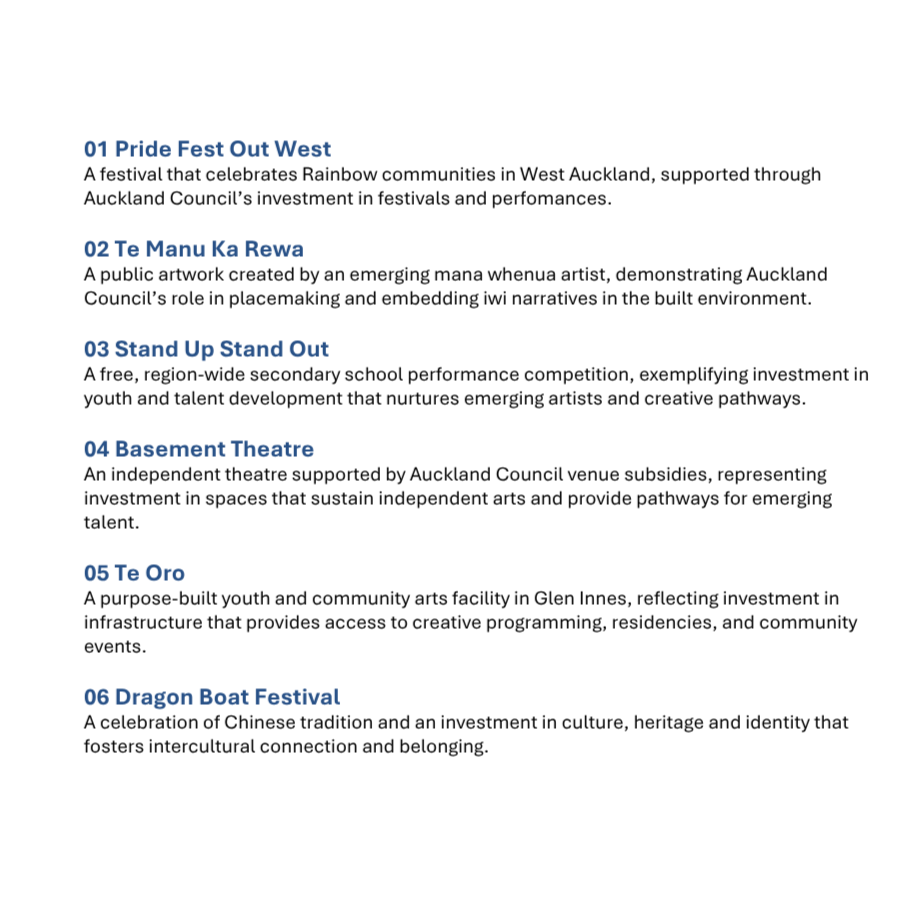
In the Arts Matter evaluation we undertook with Auckland Council, we explored the value of the arts to Auckland communities, and how council investment contributes, through the lens of six case studies in the Tāmaki Makaurau region.
In undertaking this research, we applied a Value for Investment approach. This takes a broad view of value – including but not limited to economic value. It sees value beyond dollar terms to what it is about something that matters to people, and this requires input from many different perspectives.
The case studies
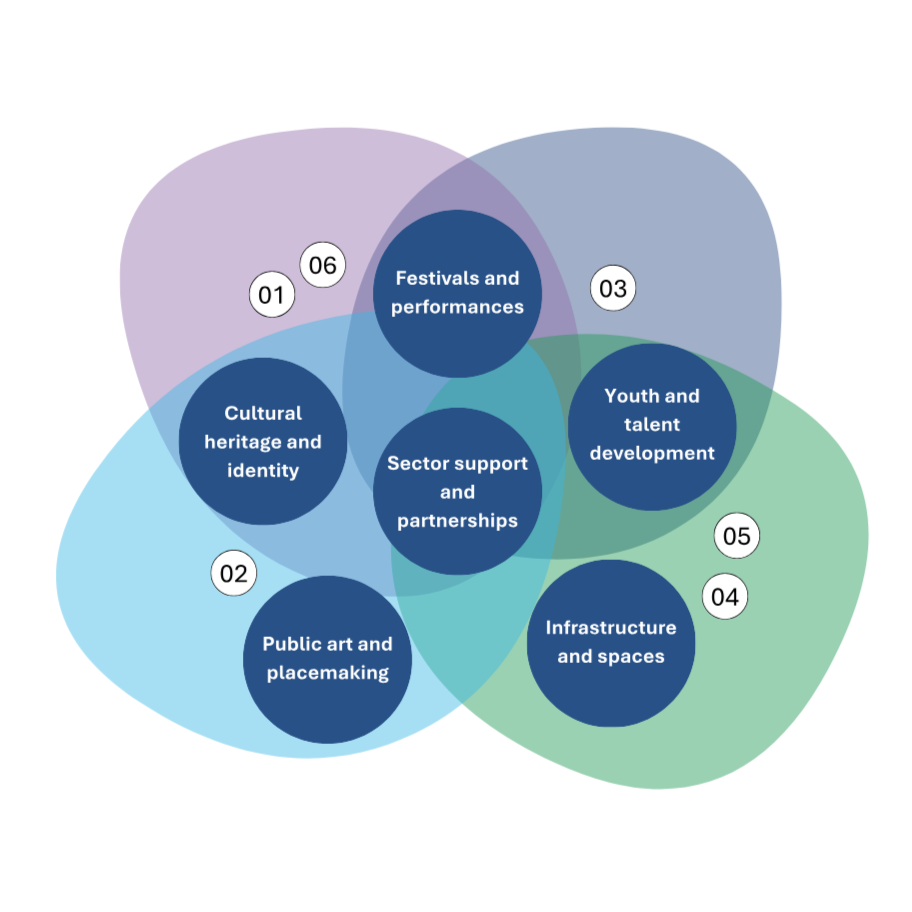
There was a deliberate effort to look at initiatives that are somewhat outside the mainstream, rather than established professional arts organisations. The diagram below highlights that we looked at a diverse range of arts initiatives, organisations and projects.
We looked at art in a broad sense, encompassing festivals and performances, youth talent and development, infrastructure and spaces, public art and placemaking, and cultural heritage and identity. Across all of these was a council role in offering sector support and partnerships.
Assessing value
In the design of the evaluation, we collaboratively built with council teams a value framework, to provide a structured approach to understanding value. We identified three areas of value, each with their own criteria that we developed.
Stewardship of resources: This is about how council manages, supports and holds accountability for its arts investment. The resources that council brings are much more than just funding, there are also a range on other supports, such as venues, relational connections, and capability development.
Building artistic, social and cultural capital: We deliberately used the idea of capital here, because when you invest in capital you get a return over time, but to get that return, you have nurture and maintain it. So this looks at different types of capital that is being developed and sustained through arts investment. These go beyond just delivery of arts and culture activities, but also look at community and iwi relationships, showcasing mātauranga and ngā toi Māori, and fostering leadership in the arts.
Generating social and economic value: These are the end results of arts investment that support communities and the wider city in different ways. They encompass the growth of te ao Māori, cohesive communities, economic growth, sense of place and engaged citizenry.
We explored each initiative individually, but we also looked at the collective value that council arts investment brings.
Investing for success
Some of the key learning for arts investment were:
Diverse investment types: The types of support and investments made by the council in arts and culture programmes extended beyond operational funding, and included staff resources and support, lease of venues and facilities, rent subsidies and capability building support.
Partnerships and relationships: Sustaining strong, mutually beneficial relationships with programme partners is key to leveraging the most value from investments, and often involves brokering connections with other organisations or parts of council.
Ngā toi Māori and Māori ownership: It was evident in case studies that drew on ngā toi Māori that centring Māori ownership and design is a key enabler of art that resonates with and has the support of wider Māori communities and iwi.
Co-investment: Auckland Council funding is often a critical funding stream, but the reality for arts organisations is that their sustainability, even at a project level, often depends on securing co-investment funding from a range of sources.
Community co-design: Activities and venues that drew on community input and co-design also demonstrated a high-level of cohesion and participation with their communities (whether ethnic, geographic or communities of interest).
How can we generate more value?
Finally, we looked at how can we generate more value from arts investment. Key areas were:
In terms of core funding, for all organisations and projects we met with, there were challenges of short-term, one-off funding. The question we have is can funding be used in ways that enable arts organisations to plan and innovate, through increased use of flexible and multi-year funding?
Capacity development was a need for many, with challenges in navigating council systems, timelines, funding sources and milestones.
With iwi relationships, we found council systems were at times not an easy fit, and are there opportunities to create approaches that work better for all concerned?
The evidence base that many arts initiatives relied on were quite limited. We can see lots of opportunities to build better monitoring systems, even if they were just simple feedback approaches to be better able to tell their own story of value and impact.
There may also be more opportunities to develop local leadership in the arts, through residencies, internships and employment pathways, enabling growth and succession in the arts in the city.
Lastly, while economic benefits are not central to arts initiatives, are there opportunities to get better at identifying the different economic benefits, like business investment, vendor participation and career development?
Arts do matter!
We can see from these case studies that arts are a key part of the fabric and identity of Tāmaki Makaurau. They link landscapes with the act of place-making and weaving in the history and cultures of the region. They contribute to sense of community and community connection. They bring to life and foster mātauranga Māori and ngā toi Māori. They support career and leadership development. And lastly, all in their own way contribute to the creative economy of the region.
A copy of the full evaluation report can be accessed here, and a video recording of the Auckland Conversations presentation on Arts Matter can be found here.
Acknowledgements
We’d like to express our deepest gratitude to all who took part in the research, from the participating case studies, community partners, and of course to Auckland Council for commissioning the evaluation and active collaboration in its design and sense-making. Our special thanks to Cat Ruka who collaborated with us in all stages of the project.